
TL;DR

Get wellness gear delivered free with Prime
- Fast, free delivery on millions of items
- Prime Video, Amazon Music and more included
- Member-only deals all year
Fit&Well recommends shoulder presses, bodyweight squats, planks, dumbbell rows and glute bridges as a simple home strength routine for beginners. Personal trainer Chris Browning says the exercises are relatively easy to learn and can be progressed over time; the report suggests starting with light dumbbells and two to three sets.
Fit&Well has published a five-exercise home strength routine for beginners, with personal trainer Chris Browning recommending shoulder presses, squats, planks, rows and glute bridges. The report says the movements can be done at home, with light dumbbells needed for the presses and rows, and gives suggested sets and repetitions for each exercise.
Browning, who Fit&Well says has more than 20 years of experience creating home workouts, said he selected the movements because they are relatively simple to teach and learn, allow progression and together target major muscle groups. That is his professional recommendation as reported by Fit&Well, rather than evidence in the article that this is the single best routine for every beginner.
The suggested prescription is two to three sets for each movement. The report lists 10–15 repetitions for shoulder presses, squats, rows on each side and glute bridges. For planks, it gives a target of 30–60 seconds, while advising beginners to stop when the position becomes challenging or uncomfortable, or when they cannot maintain good form.
The shoulder press and row use a pair of fairly light dumbbells; the squat, plank and glute bridge use body weight. Fit&Well advises increasing the weight if the exercises start to feel easy after practicing them for a few weeks. The report does not give a weekly schedule, rest periods or a tailored plan for people with injuries or health conditions.
A Simple Starting Point at Home
The routine offers beginners a structured way to practice basic strength movements without requiring a gym. Its mix includes an upper-body push, a pulling movement, a squat, a trunk-stability exercise and a hip-extension movement, giving readers a practical set of options rather than a single isolated exercise.
That convenience may help people who prefer to train at home, but the recommendations are not a guarantee of results. Progress depends on factors such as consistent practice, appropriate resistance, recovery and individual ability. The report’s advice to use light weights and prioritize form provides a cautious entry point; readers should not treat its suggested sets and repetitions as a personalized prescription.
Products Worth Considering

BowFlex Results Series SelectTech 552 Adjustable Dumbbell

Levoit Eleva 300X HEPA Air Purifier for Home and Bedroom

Bowflex SelectTech 840 Adjustable Kettlebell
As an affiliate, we earn on qualifying purchases.
How the Five Moves Work
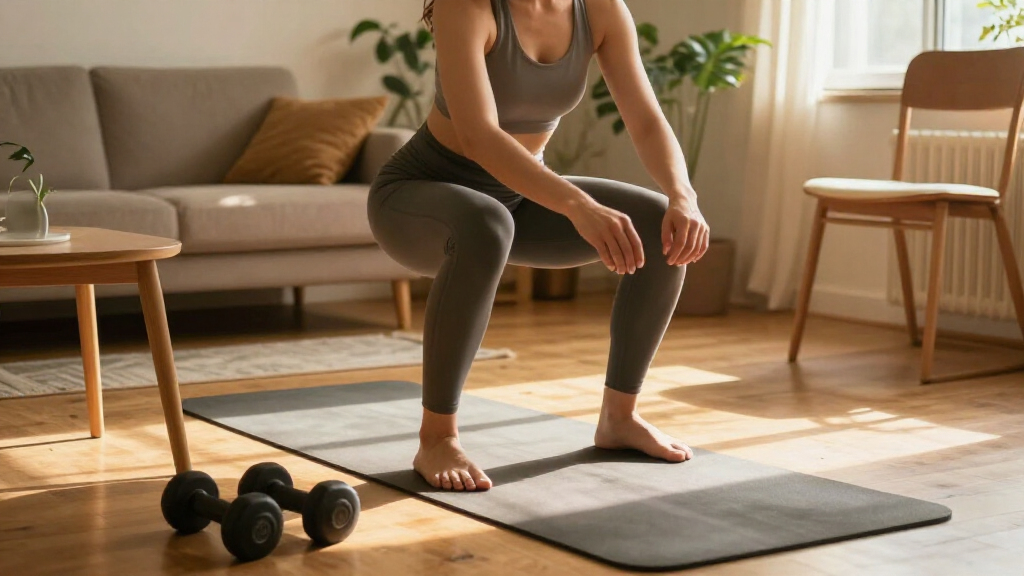
The program begins with a seated dumbbell shoulder press: sit upright with legs extended, bring weights to shoulder height, press them overhead without locking the arms, then lower under control. The bodyweight squat starts with feet about shoulder-width apart; lower only as far as comfortable while keeping the knees aligned with the toes, then stand by pushing through the feet.
For the plank, the report describes a straight body line with forearms on the floor and elbows beneath the shoulders. In the dumbbell row, start on hands and knees, keep the back flat, pull one weight toward the hip with the elbow close to the body, lower it and switch sides after 10–15 repetitions. The glute bridge is performed lying on the back with knees bent and feet flat; lift the hips until the body forms a line from chest to knees, squeeze the glutes and lower slowly.
These details are drawn from Fit&Well’s exercise instructions. The article does not provide independent testing or comparative evidence ranking these five moves against other beginner routines.
Limits of the Routine’s Guidance
The supplied report does not state when it was published, cite research comparing the exercises with alternatives or provide details about how often beginners should complete the routine. It also does not specify rest periods, warm-up guidance, weight-selection tests or modifications for different abilities.
Readers with pain, an injury or a health condition may need individual guidance before starting. Exercise demonstrations and written cues cannot confirm that a person’s form is correct, and the report’s general recommendations may not suit everyone. The article does not claim that the routine prevents or treats any medical condition.
Progress After Building Familiarity
Fit&Well’s next step is gradual: practice the movements with manageable resistance, and consider increasing the dumbbell weight after a few weeks if the exercises feel easy. Beginners can use the listed repetition and time ranges as starting targets, while maintaining controlled movement and stopping when they cannot keep proper form.
The report does not set a calendar for progression or say how quickly to add weight. Anyone unsure about technique or exercise suitability can seek advice from a qualified fitness professional or healthcare provider, particularly when managing a pre-existing condition.
Key Questions
Which five exercises does the report recommend?
Fit&Well recommends the seated dumbbell shoulder press, bodyweight squat, plank, dumbbell row and glute bridge, based on personal trainer Chris Browning’s advice.
What equipment is needed?
The report calls for a pair of fairly light dumbbells for shoulder presses and rows. Squats, planks and glute bridges use body weight.
How many sets and repetitions are suggested?
Fit&Well lists two to three sets. It suggests 10–15 repetitions for the presses, squats, rows on each side and bridges, and a 30–60-second plank. Browning advises ending a plank when it becomes uncomfortable or proper form cannot be maintained.
When should a beginner increase the dumbbell weight?
The report suggests considering an increase when the exercises start to feel easy after a few weeks of practice. It does not specify how large the increase should be or provide a fixed progression schedule.
Source: fitandwell.com