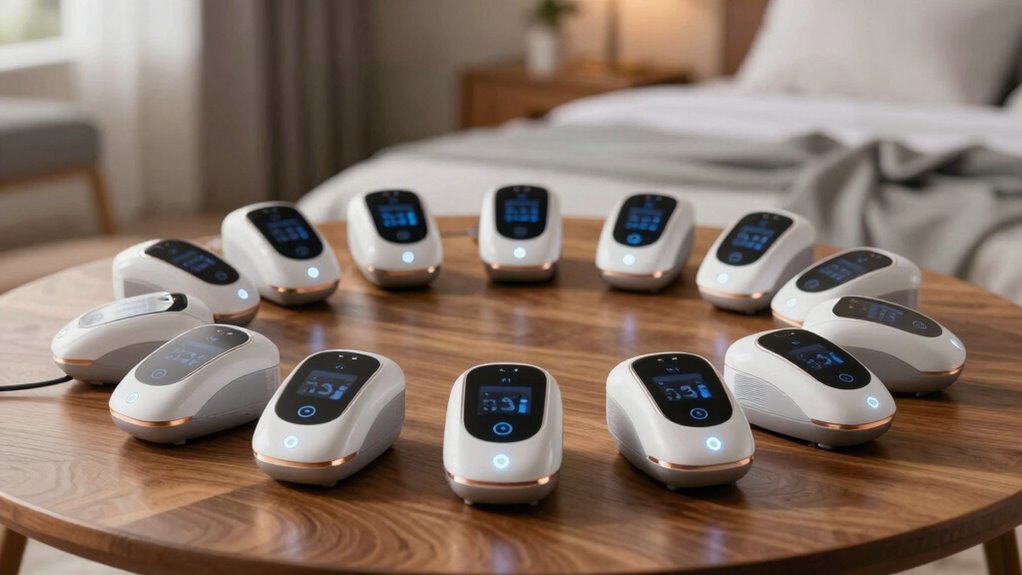

For anyone concerned about sleep quality and breathing issues, sleep breathing quality detectors offer a way to monitor airflow, oxygen levels, and overall respiratory health during sleep. The best overall pick, EMAY Sleep Oxygen Monitor with PC Software & App, provides comprehensive SpO2 tracking with detailed data, making it ideal for serious users. Garmin Index Sleep Monitor stands out for its advanced sleep analysis and health metrics, especially for wearable tech fans. Meanwhile, options like the SkyPad Contact-Free Heart & Breathing Monitor cater to elderly and children’s safety without intrusion. Choosing the right device involves balancing precision, ease of use, and budget—continue reading for the full breakdown.

Get wellness gear delivered free with Prime
- Fast, free delivery on millions of items
- Prime Video, Amazon Music and more included
- Member-only deals all year
Key Takeaways
- Multi-sensor devices like the EMAY Sleep Oxygen Monitors deliver the most detailed breathing data, but may require more setup.
- Wearable options such as the Garmin Index provide convenience and integration with broader health metrics, appealing to fitness-focused users.
- Contact-free monitors like SkyPad are best suited for elderly or children, prioritizing safety and comfort over detailed data.
- Herbal support products like Nature’s Rite focus on natural breathing aid but lack real-time monitoring capabilities.
- High-end models often combine detailed data with recording features, but come at a higher price point.
| EMAY Sleep Oxygen Monitor with PC Software & App, Bluetooth Pulse Oximeter for Overnight & Continuous SpO2 Tracking |  | Best Overall Sleep Breathing Quality Detector | Modes: Spot Check, Continuous Tracking | Memory: 72 hours | Connectivity: Bluetooth | VIEW ON AMAZON | See Our Full Breakdown |
| Sleep Detection Pad, Vital Sign Monitoring System for Sleep Quality and Remote Care |  | Best Contactless Sleep Breathing Detector | Real-time response: Yes | Contactless detection: Yes | Lightweight: Yes | VIEW ON AMAZON | See Our Full Breakdown |
| Nature’s Rite Sleep Breathing Support – All-Natural Herbal Capsules for Better Sleep and Breathing |  | Best Natural Supplement for Sleep and Breathing | Quantity: 30 Capsules | Ingredients: Lobelia, Meadowsweet, Thyme, Chamomile, Cramp Bark | Made in: USA | VIEW ON AMAZON | See Our Full Breakdown |
| EMAY Sleep Breathing Monitor for Airflow Tracking |  | Best Focused on Nasal Airflow Monitoring | Sensors: Three sensors in a probe | Material: Food-grade silicone | Weight: 10g | VIEW ON AMAZON | See Our Full Breakdown |
| Garmin Index Sleep Monitor (S/M) – Smart Sleep Band with Advanced Sleep Tracking & Recovery Metrics, HRV, Skin Temperature & Women’s Health Tracking, Garmin Connect Compatible + Wearable4U PowerBank |  | Best Wearable Sleep Tracking Band with Advanced Metrics | Size: S/M | Battery Life: Up to 7 nights | Compatibility: Garmin Connect | VIEW ON AMAZON | See Our Full Breakdown |
| SkyPad Contact-Free Heart & Breathing Monitor for Elderly and Children |  | Best Overall Contactless Monitoring System | Sensor Type: Contactless health sensor | Monitoring Features: Heart rate, breathing, sleep apnea, seizures, room temperature, humidity | Connectivity: Wi-Fi, mobile app (free) | VIEW ON AMAZON | See Our Full Breakdown |
| EMAY Sleep Oxygen Monitor with Recording Capability |  | Best for Portable, Long-Term Sleep Data Recording | Data Memory: 40 hours | Display: Large rotating digital LCD | Connectivity: Syncs data later via app | VIEW ON AMAZON | See Our Full Breakdown |
| EMAY SleepO2 Wrist Pulse Oximeter with Recording Capability |  | Best Compact, Wearable Sleep Oxygen Tracker | Battery Life: 10 hours | Weight: 20g | Adapter Output Voltage: DC 5V | VIEW ON AMAZON | See Our Full Breakdown |
More Details on Our Top Picks
EMAY Sleep Oxygen Monitor with PC Software & App, Bluetooth Pulse Oximeter for Overnight & Continuous SpO2 Tracking
This standalone device excels at providing detailed, second-by-second oxygen saturation and heart rate data without relying on a smartphone, making it ideal for those who prioritize comprehensive monitoring. Unlike the Garmin Index Sleep Monitor, which offers broader sleep tracking but less focus on oxygen levels, this monitor zeroes in on respiratory health with high-resolution data. Its rechargeable battery and easy-to-use PC software support in-depth analysis, though it requires manual syncing each morning and lacks waterproof features. This pick makes the most sense for users who want continuous, detailed oxygen and heart rate insights without complex setup or wearable devices.
Pros:- Provides detailed second-by-second oxygen and heart rate data
- No smartphone needed for operation or data review
- Rechargeable, lightweight design for ease of use
Cons:- Requires manual syncing each morning
- Limited to Bluetooth connectivity and no waterproof features
Best for: Individuals seeking precise overnight SpO2 and heart rate tracking with standalone operation
Not ideal for: Users wanting waterproof features or integrated fitness tracking in a wearable device
- Modes:Spot Check, Continuous Tracking
- Memory:72 hours
- Connectivity:Bluetooth
- Power:Rechargeable
- Compatibility:PC, iOS, Android
- Alarm:Audio alarm for low oxygen or heart rate
Our verdict“This monitor is best suited for those who want detailed respiratory data without wearable devices or smartphone dependence.”
Sleep Detection Pad, Vital Sign Monitoring System for Sleep Quality and Remote Care
This contactless sleep detection pad offers real-time vital sign monitoring without physical contact, making it highly suitable for hospital or home use where non-intrusive monitoring matters. Compared with the EMAY Sleep Breathing Monitor, which focuses on nasal airflow, this pad provides a broader assessment of sleep status and vital signs, including breathing. Its portability and ease of setup make it attractive for remote care, though specific device connectivity details are scarce, and it may require environmental adjustments for optimal use. It’s ideal for caregivers or individuals who need accurate, non-contact sleep monitoring across various settings.
Pros:- Real-time, accurate sleep and vital sign monitoring
- Non-contact and safe to use
- Portable and easy to carry
Cons:- Limited info on device connectivity options
- Setup may vary depending on environment
Best for: Caregivers monitoring sleep and vital signs remotely in hospitals or home environments
Not ideal for: Users seeking detailed respiratory airflow analysis or wearable comfort
- Real-time response:Yes
- Contactless detection:Yes
- Lightweight:Yes
- Rollable:Yes
- Suitable for:Hospitals, bedrooms, offices
Our verdict“This contactless system is perfect for remote or hospital-based sleep monitoring where non-intrusive, real-time data is needed.”
Nature’s Rite Sleep Breathing Support – All-Natural Herbal Capsules for Better Sleep and Breathing
This herbal supplement offers a holistic approach to improving sleep and supporting healthy breathing patterns, making it appealing for those preferring natural remedies over devices. Unlike the electronic EMAY Sleep Breathing Monitor, which tracks respiratory airflow, these capsules aim to enhance overall well-being through relaxation and herbal support. While they are non-habit forming and suitable for daily use, their effectiveness varies among individuals and may not provide immediate results. This product is best for users interested in natural, supportive measures rather than high-tech monitoring, with the understanding that it complements, not replaces, respiratory assessments.
Pros:- All-natural, herbal formulation
- Non-habit forming and safe for daily use
- Supports relaxation and healthy breathing
Cons:- May not work for everyone
- Contains multiple herbs that could cause allergies
Best for: Individuals preferring natural, herbal approaches to sleep and breathing support
Not ideal for: People seeking precise respiratory data or those with specific medical conditions requiring medical-grade devices
- Quantity:30 Capsules
- Ingredients:Lobelia, Meadowsweet, Thyme, Chamomile, Cramp Bark
- Made in:USA
Our verdict“This supplement suits those seeking a natural, holistic approach to sleep and breathing, but it’s less suitable for immediate or precise respiratory needs.”
EMAY Sleep Breathing Monitor for Airflow Tracking
This device specializes in nasal airflow measurement, providing detailed respiratory analysis through built-in sensors and a professional sleep report. Compared with the EMAY Sleep Oxygen Monitor, which measures oxygen saturation and heart rate, this monitor offers a more targeted insight into airflow patterns, especially useful for diagnosing nasal breathing issues. However, it only tracks nasal breathing, making it unsuitable for mouth breathers or those needing SpO2 data. Its lightweight design and easy app integration make it suitable for at-home use, though it doesn’t record pulse or oxygen levels, limiting its overall scope.
Pros:- Accurately monitors nasal airflow and sleep quality
- Provides detailed, professional sleep reports
- Lightweight and comfortable for overnight wear
Cons:- Not suitable for mouth breathers
- Cannot record SpO2 or pulse rate
Best for: Individuals specifically concerned with nasal airflow and breathing patterns during sleep
Not ideal for: Mouth breathers or users seeking comprehensive oxygen saturation data
- Sensors:Three sensors in a probe
- Material:Food-grade silicone
- Weight:10g
- Monitoring Focus:Nasal breathing
- App Compatibility:Smartphones
- Features:Sleep monitoring, respiratory event tracking, professional sleep report
Our verdict“This airflow-focused device is ideal for those with nasal breathing concerns but less suited for comprehensive respiratory monitoring.”
Garmin Index Sleep Monitor (S/M) – Smart Sleep Band with Advanced Sleep Tracking & Recovery Metrics, HRV, Skin Temperature & Women’s Health Tracking, Garmin Connect Compatible + Wearable4U PowerBank
This upper-arm sleep band excels at providing a broad spectrum of sleep data, including stages, HRV, skin temperature, and women’s health metrics, all with seamless Garmin Connect integration. Compared with the EMAY Sleep Oxygen Monitor, which focuses on oxygen and heart rate, this device offers a more comprehensive view of sleep quality, recovery, and health trends, though it does not deliver medical-grade accuracy. Its long battery life and included PowerBank make it convenient for tracking over multiple nights, but some features like Pulse Ox are not universally available, and overall ratings are moderate. It suits users interested in detailed sleep patterns combined with overall health insights.
Pros:- Tracks sleep stages, HRV, and skin temperature
- Seamless data sync with Garmin Connect app
- Long battery life of up to 7 nights with included PowerBank
Cons:- Some advanced features like Pulse Ox are limited or unavailable in some regions
Best for: Health-conscious users wanting detailed sleep and recovery metrics with wearable convenience
Not ideal for: Those needing medical-grade data or highly accurate oxygen saturation measurements
- Size:S/M
- Battery Life:Up to 7 nights
- Compatibility:Garmin Connect
- Includes:Sleep monitor, PowerBank, charging/data cable, documentation
Our verdict“This wearable band offers extensive sleep and health tracking for users who prioritize convenience and broad insights over clinical precision.”
SkyPad Contact-Free Heart & Breathing Monitor for Elderly and Children
The SkyPad stands out for its completely contactless approach, making it ideal for in-home monitoring of vulnerable populations like seniors or children who might not tolerate wearable devices. Unlike the EMAY SleepO2 Wrist Pulse Oximeter, which requires wearing a probe, SkyPad offers continuous data without skin contact, reducing discomfort and compliance issues. However, its effectiveness depends heavily on correct placement of the sensor pad, and there’s limited info on battery life or durability, which could be drawbacks in long-term use. It also lacks integration with other health devices, making it less versatile for comprehensive health tracking. This pick makes the most sense for those prioritizing non-intrusive, real-time monitoring with emergency alerts, especially in a home setting. Specs:- Sensor Type: Contactless health sensor
- Monitoring Features: Heart rate, breathing, sleep apnea, seizures, room temperature, humidity
- Connectivity: Wi-Fi, mobile app (free)
- Included Components: Sensor pad, touchscreen hub with SOS button, power adaptor
- User Compatibility: Adults and children (1 year or older)
- Subscription: None required
Pros:- Contactless and stress-free for users of all ages
- Real-time data accessible via mobile app
- Emergency alert and call feature without subscription
Cons:- Requires careful placement of sensor pad for accuracy
- Limited information on device lifespan and robustness
Best for: Families or caregivers seeking non-intrusive, continuous sleep breathing monitoring for elderly or children
Not ideal for: Users needing detailed sleep stage analysis or clinical-grade data, as it focuses more on vital signs and alerts than comprehensive sleep metrics
- Sensor Type:Contactless health sensor
- Monitoring Features:Heart rate, breathing, sleep apnea, seizures, room temperature, humidity
- Connectivity:Wi-Fi, mobile app (free)
- Included Components:Sensor pad, touchscreen hub with SOS button, power adaptor
- User Compatibility:Adults and children (1 year or older)
- Subscription:None required
Our verdict“This device is best suited for those who want a reliable, non-invasive way to monitor breathing and heart rate without wearable devices, especially in senior care or family environments.”
EMAY Sleep Oxygen Monitor with Recording Capability
The EMAY Sleep Oxygen Monitor excels at overnight blood oxygen and pulse tracking, providing up to 40 hours of continuous data storage, which surpasses many basic pulse oximeters like the EMAY SleepO2 Wrist Pulse Oximeter. Its large LCD display makes reviewing data straightforward, and the ability to export detailed reports via the app adds convenience. Compared to the SkyPad, which emphasizes contactless vital signs, this device is more suited for active individuals or athletes interested in detailed oxygen data for sleep or training. A major limitation is that it’s not designed for clinical diagnosis, and it lacks real-time connectivity, making it less ideal for immediate alerts or medical monitoring. It’s best for those who want comprehensive overnight oxygen data without needing constant connectivity. Specs:- Data Memory: 40 hours
- Display: Large rotating digital LCD
- Connectivity: Syncs data later via app
- Intended Use: Sports & aviation
Pros:- Long 40-hour data storage for thorough overnight tracking
- No need for real-time connection during sleep
- Easy to review and export detailed reports via app
Cons:- Not suitable for medical diagnosis or clinical use
- Limited to sports and aviation applications, not designed for health emergencies
Best for: Active individuals or sports enthusiasts seeking detailed overnight oxygen data for performance insights
Not ideal for: People needing real-time alerts or clinical-grade diagnostics, since it mainly records data for later review
- Data Memory:40 hours
- Display:Large rotating digital LCD
- Connectivity:Syncs data later via app
- Intended Use:Sports & aviation
Our verdict“Ideal for users who want extended, detailed oxygen tracking for sleep or athletic performance without real-time alerts or clinical validation.”
EMAY SleepO2 Wrist Pulse Oximeter with Recording Capability
The EMAY SleepO2 Wrist Pulse Oximeter offers a straightforward way to monitor blood oxygen saturation and pulse rate overnight, with the advantage of being wearable and portable. It’s particularly suitable for those who dislike bulky equipment or prefer a device that can be worn comfortably throughout sleep. Its 10-hour rechargeable battery and lightweight design make it practical for travel or frequent testing. Unlike the SkyPad, which provides contactless vital sign monitoring, this device is more personal and convenient for individual use. However, it requires users to remove their finger from the probe before downloading data via Bluetooth, which can interrupt the flow of information during the night. It’s not waterproof, so users should handle it carefully. Overall, it’s well-suited for those wanting a simple, wearable oxygen monitor with detailed data export options. Specs:- Battery Life: 10 hours
- Weight: 20g
- Adapter Output Voltage: DC 5V
- Adapter Output Current: 1000 mA
Pros:- Continuous overnight data recording without smartphone dependency
- Lightweight and comfortable for sleep
- Rechargeable with a long battery life of 10 hours
- Allows review and sharing of detailed sleep reports
Cons:- Requires removing finger from probe before data download
- No waterproof features, so careful handling is needed
Best for: Sleepers who prefer a lightweight, wearable device for overnight oxygen monitoring and detailed report sharing
Not ideal for: Users seeking continuous or multi-night monitoring without interruption, as it requires finger removal for data download
- Battery Life:10 hours
- Weight:20g
- Adapter Output Voltage:DC 5V
- Adapter Output Current:1000 mA
Our verdict“This pick suits those who want a portable, comfortable wearable oxygen monitor with reliable overnight data collection and easy report sharing.”

How We Picked
These products were evaluated based on their ability to accurately monitor sleep breathing quality, ease of use, build quality, and relevance for different user needs. We prioritized devices that offer detailed airflow and oxygen tracking, as well as those with user-friendly interfaces and reliable data recording. Cost-effectiveness was also considered, ensuring options for various budgets, from entry-level to premium. The ranking reflects a balance between performance, versatility, and practicality for everyday sleep monitoring.Factors to Consider When Choosing Sleep Breathing Quality Detectors
When selecting a sleep breathing quality detector, it’s important to consider not only the device’s technical capabilities but also how it fits into your lifestyle. Factors like ease of use, data accuracy, and integration with health apps can significantly impact your experience. Understanding your specific needs—whether detailed airflow data or non-intrusive monitoring—will help you choose the right device. Beware of models that promise too much without proven accuracy or those that require complex setups unless you’re comfortable with tech. A thoughtful approach to these considerations ensures you get a device that supports your sleep health effectively.Accuracy of Monitoring and Data Quality
Accurate data is vital when tracking sleep breathing. Devices with multiple sensors or those that measure oxygen saturation (SpO2) and airflow tend to be more reliable. Cheaper or simpler options may miss subtle breathing irregularities or produce inconsistent results, so consider your need for precision. For users with diagnosed sleep issues, investing in a device with clinical-grade sensors can make a meaningful difference. Remember, no device is infallible, so look for ones validated by user reviews or clinical testing where possible.
Ease of Use and Comfort
How easy a device is to operate can determine whether it becomes a hassle or a helpful tool. Wearables like wrist monitors are generally straightforward but may require charging and proper fitting. Contact-free options excel for convenience, especially for elderly or children, but may lack detailed data. Consider whether you prefer a device that links to your smartphone, or a standalone monitor that doesn’t require ongoing setup. Comfort during sleep is also essential; avoid bulky or intrusive devices that could disrupt your rest.
Data Recording and Analysis Features
Monitoring is just the first step—analyzing and understanding the data is equally important. Devices that record detailed metrics over time, with easy-to-read reports, help identify patterns or issues. Some monitors sync with apps that provide insights into sleep stages, oxygen dips, or breathing irregularities. If you’re managing a health condition, look for options that allow exporting data for your healthcare provider. Avoid models with limited storage or confusing interfaces, which can hinder meaningful interpretation.
Price and Value
Prices for sleep breathing detectors range from budget-friendly to premium. Cheaper models might lack detailed data or recording features but can still provide basic insights. Conversely, investing in higher-end models offers more comprehensive analysis and recording capabilities, which could be worthwhile for serious sleep health monitoring. Balance your budget against your need for precision and additional features. Remember, more expensive devices are not always better if your primary goal is simple sleep tracking or occasional use.
Additional Features to Consider
Extra features like app integration, sleep coaching, or health metrics such as HRV and skin temperature can add value if they support your broader health goals. Consider whether the device offers compatibility with your existing health apps or smart home systems. For specialized needs, such as monitoring for sleep apnea, ensure the device’s sensors are capable of detecting relevant irregularities. Be wary of devices that promise too many features without proven accuracy or user-friendly operation.
Frequently Asked Questions
Can sleep breathing detectors diagnose sleep apnea?
While many sleep breathing detectors can identify irregular breathing patterns suggestive of sleep apnea, they are not diagnostic tools. They can help flag potential issues and inform whether a professional sleep study is needed. Devices that measure airflow and oxygen saturation are more useful for preliminary screening rather than definitive diagnosis. If you suspect sleep apnea, consult a healthcare provider for comprehensive testing and diagnosis based on clinical sleep studies.
Are contact-free monitors accurate enough for medical use?
Contact-free monitors are designed primarily for convenience and safety, especially for elderly or children, and can provide useful insights into sleep breathing patterns. However, they generally lack the precision and detailed data required for medical diagnosis. These devices are best used for general monitoring or safety alerts rather than detailed medical assessments. For serious health concerns, always seek evaluation from a qualified healthcare professional with clinical-grade equipment.
How often should I calibrate or maintain my sleep breathing device?
Most modern devices require minimal calibration, but regular maintenance like cleaning sensors or ensuring proper fit can improve accuracy. Follow the manufacturer’s instructions for calibration if applicable, and keep sensors free of dust or debris. Battery replacement or charging schedules should be maintained to ensure continuous operation. Regularly reviewing your device’s functionality helps maintain reliable data collection, especially if you rely on it for health management.
Is it worth investing in a wearable versus a contact-free device?
Wearable devices like wristbands offer the benefit of continuous data collection and integration with broader health metrics, ideal for active users or those tracking multiple health factors. Contact-free devices prioritize comfort and ease, making them suitable for elderly users or children who might find wearables intrusive. The choice depends on your comfort with tech, the level of detail you need, and whether you prefer convenience over detailed data. Each type has tradeoffs in accuracy, comfort, and usability.
What should I look for if I want to monitor sleep breathing irregularities over time?
Opt for a device that offers long-term data recording, easy data export, and detailed sleep analysis reports. Compatibility with apps that track trends over weeks or months can reveal patterns or emerging issues. Look for features like automatic recording, alerts for irregularities, and the ability to compare night-to-night data. Investing in a device with cloud storage or sync capabilities ensures you can review progress or share data with healthcare providers when needed.
Conclusion
For general users aiming to improve sleep quality, the Garmin Index Sleep Monitor offers a balanced mix of advanced sleep tracking and ease of use. Those with specific health concerns or interested in detailed airflow and oxygen data should consider the EMAY Sleep Oxygen Monitor with PC Software & App, which provides comprehensive metrics. Families or elderly individuals seeking a safe, contact-free option will find the SkyPad Contact-Free Heart & Breathing Monitor best suited. Budget-conscious buyers can choose simpler models without sacrificing core functionality, while premium users may prefer devices with extensive recording and analysis features. Match your choice to your priorities, and you’ll find a device that supports your sleep health effectively.