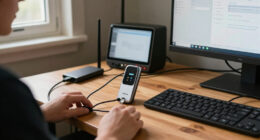
Bluetooth sleep sensors differ most in what they measure and whether you have to wear anything at all. My strongest pick for people who want overnight oxygen and pulse data without keeping a phone nearby is the EMAY SleepO2, while the Wellue O2Ring models suit buyers who want Bluetooth reports and vibration reminders. If comfort matters more than direct oxygen readings, the millimeter-wave radar tracker avoids a finger sensor entirely.

Get wellness gear delivered free with Prime
- Fast, free delivery on millions of items
- Prime Video, Amazon Music and more included
- Member-only deals all year
Those distinctions matter because these products do not offer interchangeable kinds of sleep information. The wearable oximeters record SpO2 and pulse rate; the radar unit tracks breathing, heart rate, and estimated sleep stages. I ranked them by how well their approach fits overnight use, the usefulness of stored or shared data, and the practical limits buyers should know about. All four are general-wellness or sports-and-aviation devices, not tools for diagnosing or treating a medical condition.
Key Takeaways
- The EMAY SleepO2 stores overnight SpO2 and pulse readings on the device, so it is the clearest choice when phone-free recording matters more than longer battery life.
- The Wellue O2Ring B08HDGBF7P pairs a lightweight ring with vibration reminders, app and PC reports, and up to 16 hours of operation; finger fit remains a limitation.
- The radar tracker is the only fully contactless pick and adds breathing and sleep-stage estimates, but it needs 2.4GHz Wi-Fi and can be affected by objects around the bed.
- The Wellue O2Ring B08VW3VQKW shares the other Wellue model’s core tracking strengths, so its best fit is a buyer who values its stated app compatibility and silicone-ring description.
- None of these options should be used to diagnose sleep apnea, low oxygen, or another health condition; select by comfort and data workflow, and seek clinical guidance for health concerns.
| EMAY SleepO2 Wrist Pulse Oximeter with Recording Capability |  | Best Overall for Phone-Free Overnight Recording | Data recorded: SpO2 and pulse rate | Recording: Continuous overnight recording with built-in storage | Battery life: Up to 10 hours of continuous recording | VIEW ON AMAZON | See Our Full Breakdown |
| Wellue O2Ring Wearable Pulse Oximeter with Bluetooth and Vibration Reminder |  | Best for Connected Reports and Threshold Reminders | Measurements: SpO2 and heart rate | Measuring range: 70%–99% SpO2 | Battery life: Up to 16 hours | VIEW ON AMAZON | See Our Full Breakdown |
| Non-Wearable Smart Sleep Tracker with Millimeter-Wave Radar |  | Best Contactless Pick | Technology: Millimeter-wave radar | Connectivity: 2.4GHz Wi-Fi | Wear style: Non-wearable and contactless | VIEW ON AMAZON | See Our Full Breakdown |
| Wellue O2Ring Oxygen Monitor with Vibration Reminder |  | Best Alternative Wellue Ring for App Compatibility | Measurements: SpO2 and pulse rate | Material: Silicone | Battery life: 12–16 hours | VIEW ON AMAZON | See Our Full Breakdown |
| bluetooth sleep sensor | Battery life | Connectivity | Weight | Intended use |
|---|---|---|---|---|
| EMAY SleepO2 Wrist Pulse Oxime | Up to 10 hours of continuous recording | — | 20 g | Sports and aviation only; not for medical use |
| Wellue O2Ring Wearable Pulse O | Up to 16 hours | Bluetooth | 15 g | Sports and aviation; not intended for medical use |
| Non-Wearable Smart Sleep Track | — | 2.4GHz Wi-Fi | — | — |
| Wellue O2Ring Oxygen Monitor w | 12–16 hours | Bluetooth 4.0 BLE | — | — |
More Details on Our Top Picks
EMAY SleepO2 Wrist Pulse Oximeter with Recording Capability
I put the EMAY SleepO2 first because its strongest practical distinction is straightforward: it can record overnight SpO2 and pulse rate to built-in storage without a smartphone. For someone who does not want a phone beside the bed or does not want to rely on a live connection, that makes the data workflow simpler than either Wellue ring. Readings can still be viewed in the EMAY app in real time, so phone-free recording does not mean the product is entirely disconnected.
The 20 g design and ultra-soft finger probe are intended to keep the sensor manageable through the night, though any finger-worn device may feel intrusive to a person who dislikes sleeping with something attached. Its limit is the battery: up to 10 hours of continuous recording is shorter than the Wellue models’ stated maximum of up to 16 hours. I would choose this model for its independent recording rather than for its endurance or reporting ecosystem.
Compared with the Wellue O2Ring B08HDGBF7P, the EMAY trades vibration reminders and app-plus-PC charts for less dependence on a phone during capture. It also differs from the radar tracker, which avoids contact but does not claim direct SpO2 tracking. The EMAY is not intended for medical use; its overnight readings are not a basis for diagnosing a condition.
Pros:- Records SpO2 and pulse continuously with built-in storage, without a smartphone.
- Provides real-time readings through the EMAY app.
- Light 20 g design with an ultra-soft finger probe.
- Captures overnight data in a wearable format rather than relying on bedside positioning.
Cons:- Up to 10 hours of continuous recording is less than the Wellue models’ stated maximum.
- Intended for sports and aviation use, not medical use.
Best for: Sleepers who want overnight SpO2 and pulse recording stored on the device, without needing a smartphone during the recording.
Not ideal for: People who need more than 10 hours of continuous recording, dislike finger probes, or want a device intended for clinical decisions.
- Data recorded:SpO2 and pulse rate
- Recording:Continuous overnight recording with built-in storage
- Battery life:Up to 10 hours of continuous recording
- App:EMAY app for real-time readings
- Weight:20 g
- Probe:Ultra-soft patented finger probe
- Intended use:Sports and aviation only; not for medical use
Our verdict“I recommend the EMAY SleepO2 when phone-free overnight SpO2 and pulse recording is the deciding factor, provided its 10-hour limit suits your sleep schedule.”
Wellue O2Ring Wearable Pulse Oximeter with Bluetooth and Vibration Reminder
The Wellue O2Ring B08HDGBF7P is the connected-data pick. It tracks blood oxygen saturation and heart rate, syncs by Bluetooth, and works with both an app and PC software for charts, reports, and sharing. Its vibration reminders add a different kind of feedback from the EMAY: users can set SpO2 and heart-rate thresholds and receive an alert from the wearable rather than relying only on a later review of stored data.
Its stated up-to-16-hour battery life and storage for four groups of 10-hour data make it more flexible for longer recording sessions than the EMAY’s 10-hour maximum. The tradeoff is fit. The ring is specified for a finger circumference of 2–3.2 inches, so buyers should check that range rather than assume a comfortable fit. It is also still a finger-worn sensor; the radar tracker is the better match for someone who wants no wearable at all.
This model and the other Wellue O2Ring in this guide overlap heavily in purpose. I rank this one above the B08VW3VQKW because its listing spells out the threshold reminders and app-plus-PC reporting workflow. Neither is a medical monitor, and vibration alerts should not be treated as a clinical warning system. Choose it for connected trend review and configurable reminders, not diagnosis.
Pros:- Tracks blood oxygen saturation and heart rate continuously in a lightweight ring format.
- Offers vibration reminders for preset SpO2 and heart-rate thresholds.
- Provides app and PC charts, reports, and sharing options.
- Stores up to 40 hours of data and runs for up to 16 hours per charge.
Cons:- Finger fit is limited to a 2–3.2-inch circumference.
- Not intended for medical use or diagnosis.
Best for: Buyers who want a wearable SpO2 and heart-rate tracker with Bluetooth syncing, PC reporting, stored data, and vibration reminders.
Not ideal for: People whose finger circumference falls outside the stated range, anyone avoiding wearables, or anyone seeking a medical-grade monitor.
- Measurements:SpO2 and heart rate
- Measuring range:70%–99% SpO2
- Battery life:Up to 16 hours
- On-device storage:Four groups of 10 hours of data
- Weight:15 g
- Connectivity:Bluetooth
- Software:App and PC software
- Finger circumference:2–3.2 inches
- Intended use:Sports and aviation; not intended for medical use
Our verdict“I’d choose this Wellue O2Ring over the EMAY when Bluetooth reports and threshold vibrations matter more than phone-free capture.”
Non-Wearable Smart Sleep Tracker with Millimeter-Wave Radar
The millimeter-wave radar tracker takes a different route from the other three picks: it monitors sleep without a finger sensor, wrist device, or camera. It is described as tracking heart rate, breathing, and REM, light, and deep sleep patterns, making it a better fit for someone who prioritizes an unobstructed night over direct oxygen readings. Built-in white noise, ambient lighting, routine reminders, and remote alerts extend its role beyond a basic sensor.
That contactless approach is its main advantage and its main compromise. Unlike the EMAY and Wellue rings, it does not list SpO2 measurement, so it cannot stand in for an oximeter when oxygen data is the specific need. Its 2.4GHz Wi-Fi requirement may also rule it out in homes that rely on 5GHz networks, and fans, curtains, or mosquito nets can affect performance. A wearable is more self-contained, while this model depends on both the room setup and network.
I rank it third because contact-free comfort is valuable, but the product’s environmental and Wi-Fi requirements narrow its fit. Privacy-conscious buyers may prefer radar to camera-based monitoring, while family members may appreciate remote sleep-status alerts. It remains a general-wellness device, not a diagnostic system, and estimated stages should not be read as clinical findings.
Pros:- Tracks without physical contact and does not use a camera.
- Reports heart rate, breathing, and REM, light, and deep sleep estimates.
- Includes white noise, ambient lighting, reminders, and remote alerts.
- Can share sleep status with family members remotely.
Cons:- Requires a 2.4GHz Wi-Fi network; 5GHz is not supported.
- Fans, curtains, and mosquito nets may affect performance.
- Does not list direct SpO2 tracking and is not for medical diagnosis.
Best for: People who refuse to sleep with a wearable and want contactless breathing, heart-rate, and estimated sleep-stage tracking.
Not ideal for: Buyers who specifically need SpO2 readings, have only 5GHz Wi-Fi, or cannot control nearby fans, curtains, or other sources of interference.
- Technology:Millimeter-wave radar
- Connectivity:2.4GHz Wi-Fi
- Wear style:Non-wearable and contactless
- Tracking:Heart rate, breathing, and sleep-stage analysis
- Sleep stages:REM, light, and deep sleep estimates
- Additional features:White noise, ambient lighting, and routine reminders
- Alerts:Remote alerts for family monitoring
- Medical use:General wellness only
Our verdict“I’d pick the radar tracker for contactless comfort, but not as a substitute for either Wellue or EMAY when oxygen readings are the priority.”
Wellue O2Ring Oxygen Monitor with Vibration Reminder
The Wellue O2Ring B08VW3VQKW fills much the same role as the other Wellue: a silicone finger ring that records SpO2 and pulse rate, syncs to an app, and uses vibration reminders for abnormal readings. The listed 12–16-hour battery range and four groups of 10-hour storage put it in the same broad endurance class as the B08HDGBF7P, and its free iOS and Android app plus PC software support detailed charts and trends.
Its more specific compatibility details may help buyers who want to check their existing phone before choosing: it lists Bluetooth 4.0 BLE, iOS 9.0 or later, and Android 5.0 or later. The stated finger perimeter is 2.17–3.15 inches, a slightly different fit range from the B08HDGBF7P listing. I would compare those ranges carefully rather than assuming the two rings fit exactly alike. Both offer a wearable oxygen-tracking workflow; neither gives the EMAY’s stated phone-independent recording emphasis or the radar tracker’s no-contact comfort.
This is a close alternative rather than a fundamentally different product. Its silicone design and stated compatibility make it a reasonable pick when those details match your needs, but it shares the core limits of the lineup’s wearable oximeters: a ring may bother some sleepers, fit is restricted, and the product is not for medical diagnosis. Choose it for Bluetooth trend reports and ring-style convenience, not for a different category of sleep analysis.
Pros:- Tracks SpO2 and pulse rate with Bluetooth app syncing.
- Offers vibration reminders and automatic data upload.
- Supports reports and trends through the app and PC software.
- Lists compatibility with iOS 9.0+ and Android 5.0+.
Cons:- Full data analysis and reporting require an app or PC connection.
- Finger fit is limited to a 2.17–3.15-inch perimeter.
- Intended for sports and aviation rather than medical diagnosis.
Best for: Buyers who want a silicone Bluetooth oximeter ring and want to check stated iOS, Android, and finger-perimeter compatibility before purchase.
Not ideal for: People who need phone-free capture, want a contactless sensor, fall outside the stated finger range, or need clinical monitoring.
- Measurements:SpO2 and pulse rate
- Material:Silicone
- Battery life:12–16 hours
- Connectivity:Bluetooth 4.0 BLE
- Compatibility:iOS 9.0+ and Android 5.0+
- Finger perimeter:2.17–3.15 inches
- Storage:Four groups of 10-hour data
- Reporting:App and PC software
- Use case:Sports and aviation
Our verdict“I’d choose this Wellue model when its listed phone compatibility and finger range suit you; otherwise, compare it closely with the near-identical B08HDGBF7P.”

How We Picked
I compared these four products by asking what an overnight buyer needs from a Bluetooth sleep sensor: a tolerable setup for sleeping, data that remains available in the morning, and a clear explanation of what the readings can and cannot tell you. I gave weight to continuous recording, on-device storage, app or PC access, battery life, and the burden of wearing or positioning a sensor. A Bluetooth connection is useful, but it is not the whole point; a device that keeps recording without a phone can be more practical than one with a richer connected workflow.
I also separated unlike categories rather than treating every sleep metric as equivalent. The EMAY and Wellue options are finger-worn oximeters that track SpO2 and pulse. The radar product is contactless and describes heart-rate, breathing, and sleep-stage tracking; it does not provide the same direct oxygen measurement. I ranked the EMAY first for phone-free overnight capture, the first Wellue next for its fuller connected reporting and reminders, the radar unit for people who reject wearables, and the second Wellue model as a close alternative with similar core tradeoffs. Their wellness-only or sports-and-aviation intended use is a meaningful limit across the lineup.
| bluetooth sleep sensor | Intended use | Measurements |
|---|---|---|
| EMAY SleepO2 Wrist Pulse Oxime | Sports and aviation only; not for medical use | — |
| Wellue O2Ring Wearable Pulse O | Sports and aviation; not intended for medical use | SpO2 and heart rate |
| Non-Wearable Smart Sleep Track | — | — |
| Wellue O2Ring Oxygen Monitor w | — | SpO2 and pulse rate |
Factors to Consider When Choosing Bluetooth Sleep Sensors
I’d start by deciding which kind of overnight information you actually want. These products split into wearable oximeters and a contactless radar monitor, and that choice matters more than the Bluetooth label.Choose the measurement before the device
If your focus is SpO2 and pulse rate, compare the EMAY and Wellue rings. Their records concern oxygen saturation and pulse, not a complete clinical assessment of sleep. If you want breathing and estimated sleep-stage information without wearing a sensor, the radar model has a different purpose. It does not list SpO2 tracking, so I would not select it to answer an oxygen-specific question.
Sleep-stage estimates and oxygen readings are not interchangeable. Think about the question you want the device to help you observe, then match its listed measurements to that question. None of these products is described as a medical diagnostic device.
Match the recording method to your sleep habits
The EMAY stores data on the device and can record without a smartphone, which is useful for buyers who want a simple overnight capture routine. The Wellue models add Bluetooth syncing, app or PC charts, and vibration reminders, but buyers should expect a connected data workflow for reports. The radar tracker avoids a wearable but needs a suitable position and 2.4GHz Wi-Fi.
Consider whether you want feedback during the night or a record to review later. A vibration reminder is a product feature, not a promise that every reading is accurate or clinically significant. If you prefer to avoid alerts while sleeping, phone-free stored recording or contactless tracking may suit you better.
Check battery, storage, and finger fit
The EMAY’s stated continuous recording limit is up to 10 hours; the Wellue models list up to 16 hours, with on-device storage described as four groups of 10-hour data. Those figures make the Wellue rings a stronger fit for people who prioritize longer operating time, while EMAY’s advantage is recording without a phone. Check the distinction between battery runtime and storage capacity: one describes how long a charge lasts, the other how much data the device can retain.
For either wearable, check the finger circumference or perimeter range before buying. The two Wellue listings do not give identical ranges, and a ring that does not fit comfortably is a poor overnight sensor. The EMAY uses a soft finger probe rather than a ring, but it is still a wearable contact sensor.
Account for the room and network
The radar tracker shifts the setup burden away from your body and onto the bedroom. Its 2.4GHz Wi-Fi requirement rules out a 5GHz-only connection, while fans, curtains, or mosquito nets may affect performance. Before choosing it, check where it must be placed and whether the bed area has the conditions described for use.
The wearable models do not depend on bedside radar placement, but they ask you to sleep with a sensor on your finger. Your preference between contactless monitoring and a wearable is not a minor comfort detail; it is the central tradeoff between these product types.
Treat wellness readings as information, not diagnosis
All four listings describe non-medical use, with the oximeters intended for sports and aviation and the radar unit positioned for general wellness. I would use their reports as consumer information rather than as proof of a sleep or oxygen disorder. If you have symptoms, a medical concern, or readings that worry you, ask a qualified healthcare professional how to proceed instead of relying on a consumer sensor.
Also check what the app or software actually provides. Charts and trends can help organize recorded information, but they do not change the product’s intended use. The best choice here is the one whose measurements, comfort, connectivity, and limits match your purpose.
Frequently Asked Questions
Are Bluetooth sleep sensors medical devices?
These four products are not presented as medical diagnostic devices. The EMAY and Wellue oximeters are stated for sports and aviation use, while the radar tracker is for general wellness. Their readings may help you view consumer tracking data, but they should not be used to diagnose or treat a health condition. For symptoms or health decisions, speak with a qualified healthcare professional.
Which option records SpO2 overnight?
The EMAY SleepO2 and both Wellue O2Ring models list SpO2 tracking. The EMAY stands out for built-in overnight recording that does not require a smartphone during capture. The Wellue rings add Bluetooth app and PC reporting, and the B08HDGBF7P listing also specifies threshold-based vibration reminders. The contactless radar model does not list SpO2 measurement.
Can I use the radar tracker without Wi-Fi?
The listed radar tracker requires 2.4GHz Wi-Fi and does not support 5GHz, so I would not assume it can operate as a fully offline monitor. Check your home network before choosing it. Its performance may also be affected by nearby items such as fans, curtains, or mosquito nets, making room setup part of the decision.
Which sensor is most comfortable for sleep?
Comfort depends on whether you prefer a wearable or a contactless setup. The radar tracker avoids a finger device entirely, which may appeal to people who dislike sleeping with something attached, though it depends on placement and room conditions. The EMAY uses a soft finger probe, and the Wellue products use ring designs; buyers should check fit ranges and consider whether a finger-worn sensor will bother them overnight.
How should I choose between the two Wellue O2Ring models?
Both Wellue listings describe a Bluetooth ring for SpO2 and pulse tracking, with stored data, app or PC reporting, and vibration alerts. The B08HDGBF7P page specifies its app-and-PC charts, threshold reminders, and 2–3.2-inch finger circumference range. The B08VW3VQKW listing gives Bluetooth 4.0 BLE, phone operating-system compatibility, and a 2.17–3.15-inch perimeter range. Compare the stated fit and compatibility details against your own needs; neither is intended for medical diagnosis.
Conclusion
For phone-free overnight oxygen and pulse recording, I’d choose the EMAY SleepO2, as long as its 10-hour continuous-recording limit is enough. Buyers who want Bluetooth charts, PC reports, and vibration reminders should compare the two Wellue O2Ring listings, with finger fit and phone compatibility deciding between them. If wearing a sensor is the deal-breaker, the millimeter-wave radar tracker is the clear contactless choice, provided your bedroom setup and 2.4GHz Wi-Fi meet its needs. I would not use any of these products for diagnosis; select the one that fits your tracking goal and seek clinical advice for health concerns.