TL;DR

Get wellness gear delivered free with Prime
- Fast, free delivery on millions of items
- Prime Video, Amazon Music and more included
- Member-only deals all year
Fit&Well published a leg workout built around three lunge variations: forward, side and curtsy lunges. The report suggests two or three sets of six to eight repetitions per leg for each movement, using bodyweight or dumbbells; it does not provide research showing that this exact routine builds glutes for everyone.
Fit&Well has published a weekly leg-workout sequence combining forward, side and curtsy lunges, with dumbbells optional, for readers seeking a lower-body strength routine. The report recommends two or three sets of six to eight repetitions per leg for each variation, while framing the exercises as a way to work the glute muscles and other lower-body areas.
The routine pairs three directions of movement: a forward lunge, a lateral or side lunge, and a curtsy lunge, in which one foot steps back and across behind the other. Fit&Well’s report says the variations engage the gluteus maximus, medius and minimus, alongside other muscles involved in lower-body movement and stability. That is the report’s training rationale, rather than evidence that this particular sequence guarantees a specific result.
For each exercise, the instructions call for six to eight reps on each side and two or three sets. The forward lunge starts with a step ahead and a controlled bend of both knees; the side lunge shifts the hips back over the stepping leg while the other leg stays straight; and the curtsy variation steps one foot diagonally behind the other. Each movement ends by pushing through the working foot to return to standing.
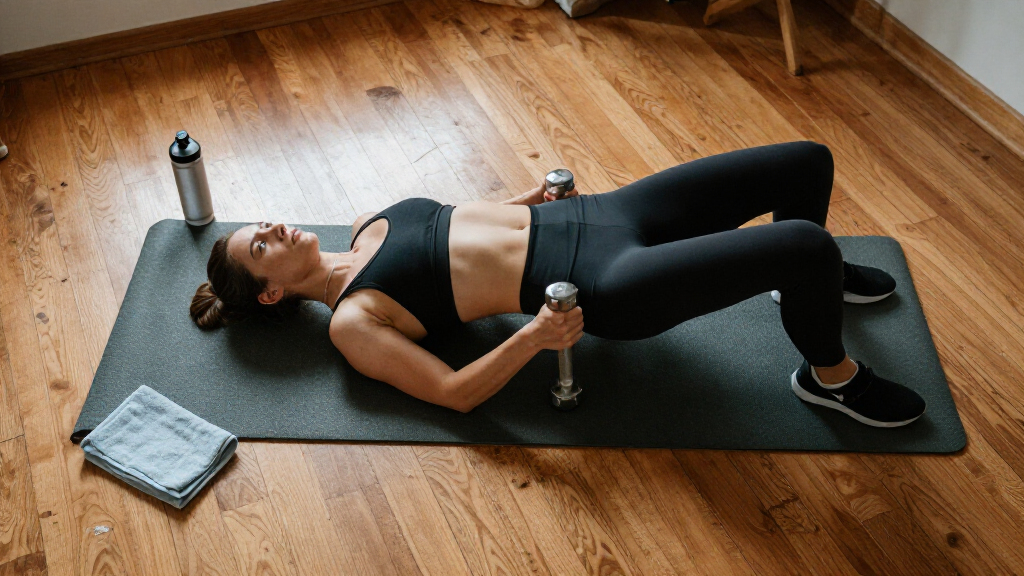
Fit&Well says the workout can be done with dumbbells held at the sides or shoulders, or with one dumbbell held at the chest. Bodyweight is also an option. Its guidance is to begin weighted sessions with a bodyweight warm-up and increase resistance gradually, rather than starting with a load that makes the movements difficult to control.
A Flexible Lower-Body Session
The routine offers a compact way to add different directions of movement to a weekly strength plan, rather than relying on a single exercise pattern. For readers who already lunge comfortably, the three variations provide a practical structure that can be performed at home with little equipment, scaled from bodyweight to dumbbells.
The report also describes potential benefits for hip and ankle mobility and lower-body stability as the steps load the joints in different directions. These are the publication’s explanations, not outcomes established for every person by the article. The source provides no trial data, comparison group, or measured strength results for this exact weekly workout. Progress will depend on factors such as load, technique, training history and consistency.
Readers should choose a range of motion and resistance they can manage without pain or loss of balance. Anyone with an injury, a history of back or joint problems, or other relevant health concerns can seek guidance from a qualified health or fitness professional before adding loaded lunges.
Products Worth Considering

BowFlex Results Series SelectTech Adjustable Dumbbells (Pair)

Garmin Forerunner 55 GPS Running Smartwatch, Black

Philips Sonicare 5950 Rechargeable Electric Toothbrush with 2 Brush Heads, Pink
As an affiliate, we earn on qualifying purchases.
Why the Routine Uses Three Lunges
Fit&Well presents lunges as a complement to squats, noting that the writer uses the movements to target lower-body areas in a different way. The article describes the gluteus maximus as the largest glute muscle, with the medius and minimus positioned beneath it around the hip. It links those muscles with movements including extending the leg, moving it outward and stabilizing the pelvis.
The report’s author also says side and curtsy lunges were helpful during personal rehabilitation after a diagnosis of a bulging disc. That is an individual account, not evidence that the sequence treats back conditions or is suitable for everyone with back pain. The source recommends fitting the movements into a broader weekly workout or doing them as a short standalone session, but it does not specify a full training plan or recovery schedule.
““There’s another leg exercise I do to target parts of the glutes that squats don’t reach: the lunge.””
— Fit&Well report author
What the Workout Does Not Establish
The supplied report does not state its publication date, cite research on this exact sequence, or quantify how much strength or muscle a person could gain by doing it once a week. Its headline presents the routine as a way to build strong glutes, but the article offers exercise instructions and the author’s experience, not a guarantee of results or a tested outcome.
It also does not set out individualized guidance for people with injuries, explain how to choose a starting dumbbell weight, or say how the workout should be adjusted alongside other lower-body training. The report advises gradual loading, but readers’ suitable resistance and movement range will vary.
How Readers Can Apply the Plan
The immediate next step is to try the movements at bodyweight, using controlled repetitions and a comfortable range of motion. Fit&Well’s suggested structure is two or three sets of six to eight reps per leg for each lunge. Readers who can perform the movements steadily may add light dumbbells and increase the load gradually over time.
The source does not announce a follow-up study, additional workout schedule or measured results. Anyone using the routine should monitor how the movements feel and adjust or stop if they cause pain. People managing existing back, hip, knee or ankle concerns can consult a qualified professional for advice tailored to their circumstances.
Key Questions
What exercises are in the Fit&Well workout?
It combines forward lunges, side lunges and curtsy lunges. Each variation involves stepping in a different direction while bending the knees and hips.
How many sets and repetitions does the report recommend?
The report suggests two or three sets of six to eight repetitions on each leg for each exercise.
Do I need dumbbells to do the routine?
No. Fit&Well says the sequence can be performed with bodyweight alone. Dumbbells can be held at the sides, on the shoulders, or as one weight at the chest.
Does doing this workout once a week guarantee stronger glutes?
No guarantee is established in the report. It offers a suggested routine, but does not provide study results or predict how much strength or muscle a reader will gain.
What should I do before adding weight?
The report recommends completing a bodyweight round as a warm-up and building resistance gradually. If you have an injury or existing health concern, seek suitable professional guidance before using loaded lunges.
Source: fitandwell.com